12 s to pick the bigger place, then both snap to true scale
Overview
Bigger or Smaller? shows two outlines drawn the same size and asks which place really covers more ground. Pick one before the fuse burns down; the reveal redraws both at true scale, with each area and how many times bigger the winner is. Endless Countries and Cities games, a ten-round Weekly with a verified Hall of Fame — free in the browser, nothing to install.
The challenge
Maps lie about size. The Mercator projection on most wall and web maps swells places far from the equator, so people’s sense of which country is bigger is often wrong — and with cities, the name says nothing about where the boundary is drawn. The answer is usually a surprise, and a surprise is a game.
Familiar maps distort area the further a place is from the equator.
A city’s official boundary can be a fraction of its famous name — or many times it.
The comparison map answers a question you already have; a game asks you one.
The approach
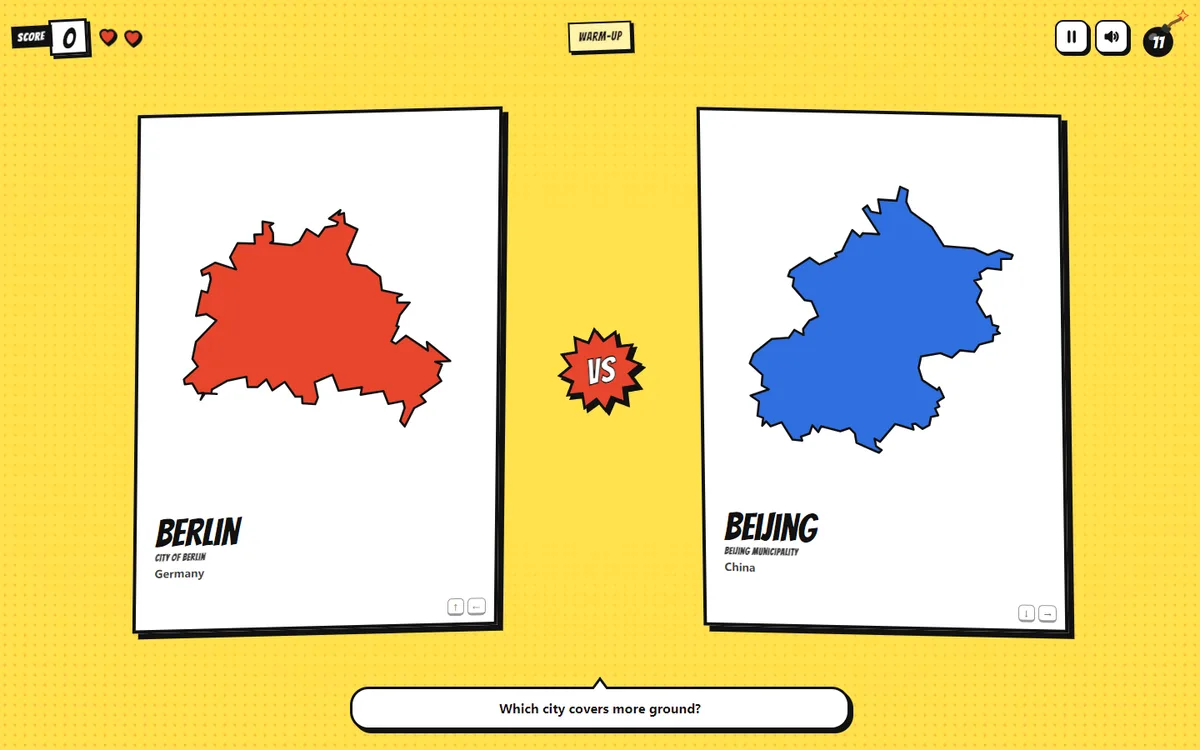
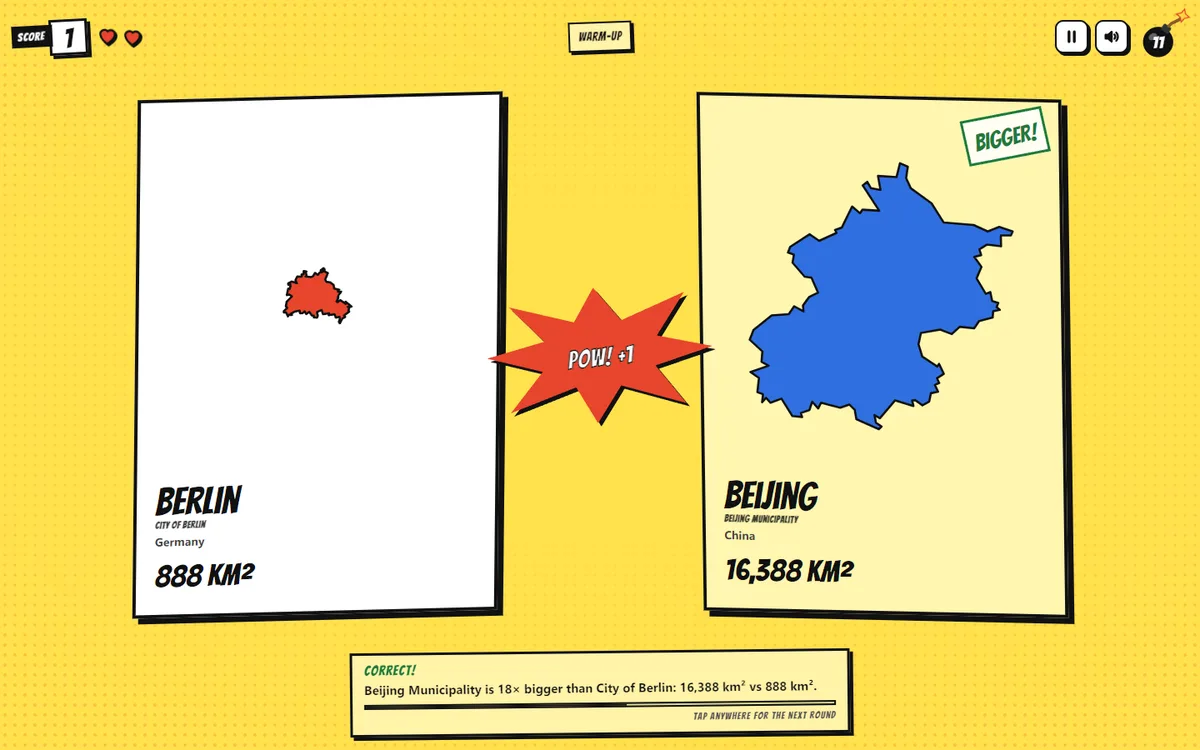
Each round puts two outlines on two cards, each drawn to fill its card so the shape gives nothing away. You pick the one you think is bigger before the twelve-second fuse burns down. Then the reveal redraws both at true scale, with the areas and the ratio between them — the moment the game is built around. Pairs get closer as your streak grows, and the Weekly gives everyone the same ten rounds to compare scores on.
Endless Countries and Cities games: two lives, one back for every ten right
Twelve seconds a round, and a true-scale reveal after every answer
Pairs from 3× apart in the warm-up down to 1.15× for experts
A ten-round Weekly whose scores the server replays and verifies
12 sto pick the bigger place, then both snap to true scale
How it works
01
Pick a game
Countries, Cities or this week’s Weekly, from comparecitysizes.com/play.
02
Choose the bigger one
Tap a card, or press an arrow key, before the fuse runs out.
03
See it at true scale
Both shapes redraw at real size, with the areas and the ratio. Space or a tap for the next round.
04
Put it on the board
Sign in, or leave a name and confirm by email, to go on the Hall of Fame. Share the score, or go again.
Screens
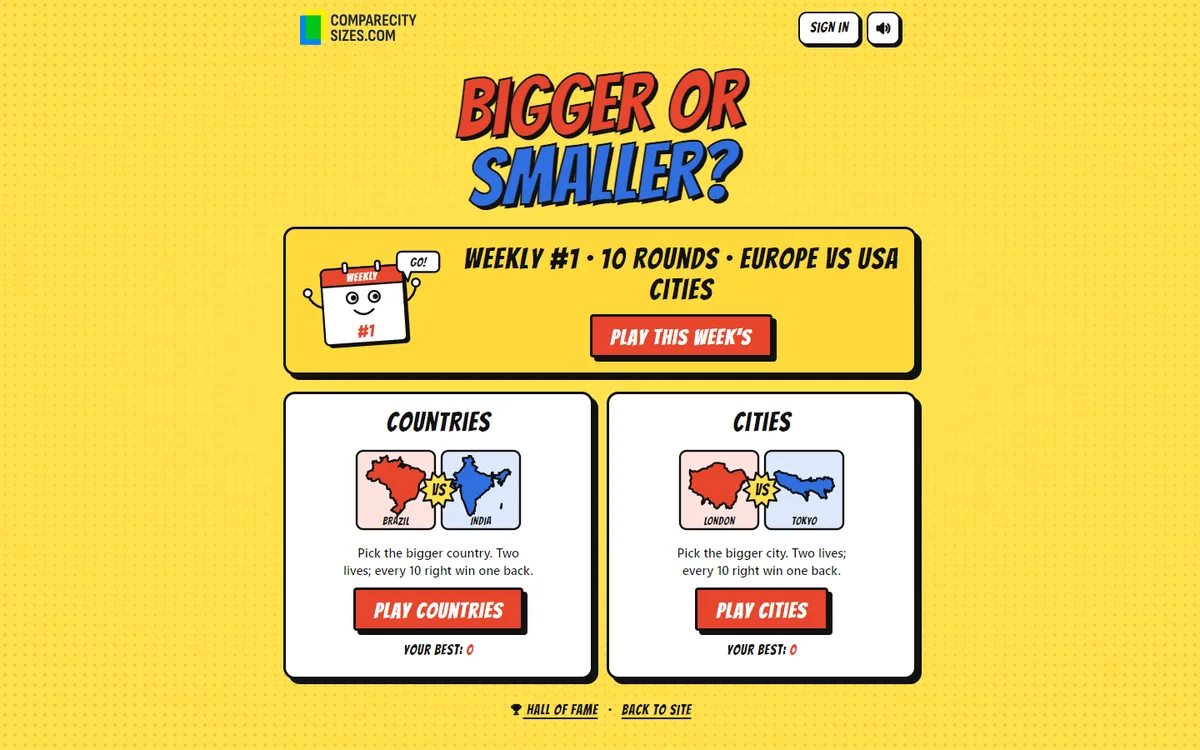
A round: Berlin against Beijing, both drawn to fill their cards, with the fuse, lives and score along the top.The reveal: the same two at true scale — Beijing Municipality is 18× bigger than the City of Berlin.The start screen: this week’s Weekly, and the endless Countries and Cities games with your best score in each.
What it does
Same size until you answer
Both outlines fill their cards, so a city state looks as big as a continent-sized country. You judge by knowledge and shape, not by pixels.
The true-scale reveal
After each pick both shapes redraw at one shared scale, with each area and the ratio — “City of Berlin is 8.4× bigger than City of Paris”.
Harder as you go
Warm-up pairs are at least 3× apart, Tricky ones 1.5–3×, Expert ones 1.15–1.5×. Nothing closer than 1.15× is ever asked, so outline simplification can never flip an answer.
Lives and a fuse
Twelve seconds a round, drawn as a burning bomb that ticks in the last three. A miss or a timeout costs a heart; two lives, and every ten right answers win one back.
The Weekly
Ten rounds, the same for everyone from Monday to Monday: five countries and five cities, getting harder as they go. A miss doesn’t end it, and there is one try a week.
A Hall of Fame you can trust
The game records every pick and its timing; the server replays the run and works out the score itself. Picks faster than a human can make are rejected, and odd runs are flagged for review.
Who uses it, and for what
Quiz and trivia players
Two minutes of geography
A round takes seconds and a run a few minutes — long enough for the surprise of finding out how small a famous place really is.
Competitive players
A weekly score to beat
The Weekly is the same ten rounds for everyone with one try, so the board is a fair fight: more right answers first, faster time second. Sharing posts the score with a row of emoji, one per round.
Teachers and students
A warm-up for a lesson on map projections
A class guesses together on the projector, and every reveal is a small lesson in why maps distort area — then the comparison map is one click away.
CompareCitySizes visitors
A second reason to visit
People who came to compare two cities find a game built on the same OpenStreetMap boundaries — and, every Monday, a new reason to come back.
Built with
Game
React 18
TypeScript
Vite
React Router
Inline SVG
Web Audio API
Rules & verification
Shared rules engine (browser + server)
Seeded RNG
Server-side replay
Back end
Node.js
Express
PostgreSQL
Prisma
Geodata
Natural Earth
OpenStreetMap via Nominatim
UN Statistics Division areas
Analytics
Google Tag Manager
GA4
What we did
Game design
Web game
Geospatial data
Difficulty tuning
Weekly challenge
Leaderboard
Anti-cheat
Sign-in & email
Synthesised sound
Sharing
Analytics
Motion & demo
Common questions
Is it free?
Yes, in any browser, with no account. An account — or a name and a confirmed email — is only needed to go on the Hall of Fame.
What does “bigger” mean?
Area, in square kilometres. For countries it is total area, land and inland water, as the UN Statistics Division reports it. For cities it is the official administrative unit named on the card — “City of Paris”, “Greater London” — which is why a city’s outline can surprise you.
How many places are there?
197 countries — the 193 UN members plus Vatican City, Palestine, Taiwan and Kosovo — and 120 cities. The two are never mixed in an Endless game; the Weekly alternates them.
How does the Hall of Fame work?
Scores are ranked by right answers, then by time. The server re-plays every run before it goes on the board, so a score cannot simply be sent in. The Weekly board starts fresh every Monday at 00:00 UTC.
Can I play with a keyboard?
Yes: the left or up arrow picks the first card, right or down the second, Space or Enter moves on, and Escape pauses — up to three times a run.
Try Bigger or Smaller?
Open the product, or talk to us about building something similar for your team.